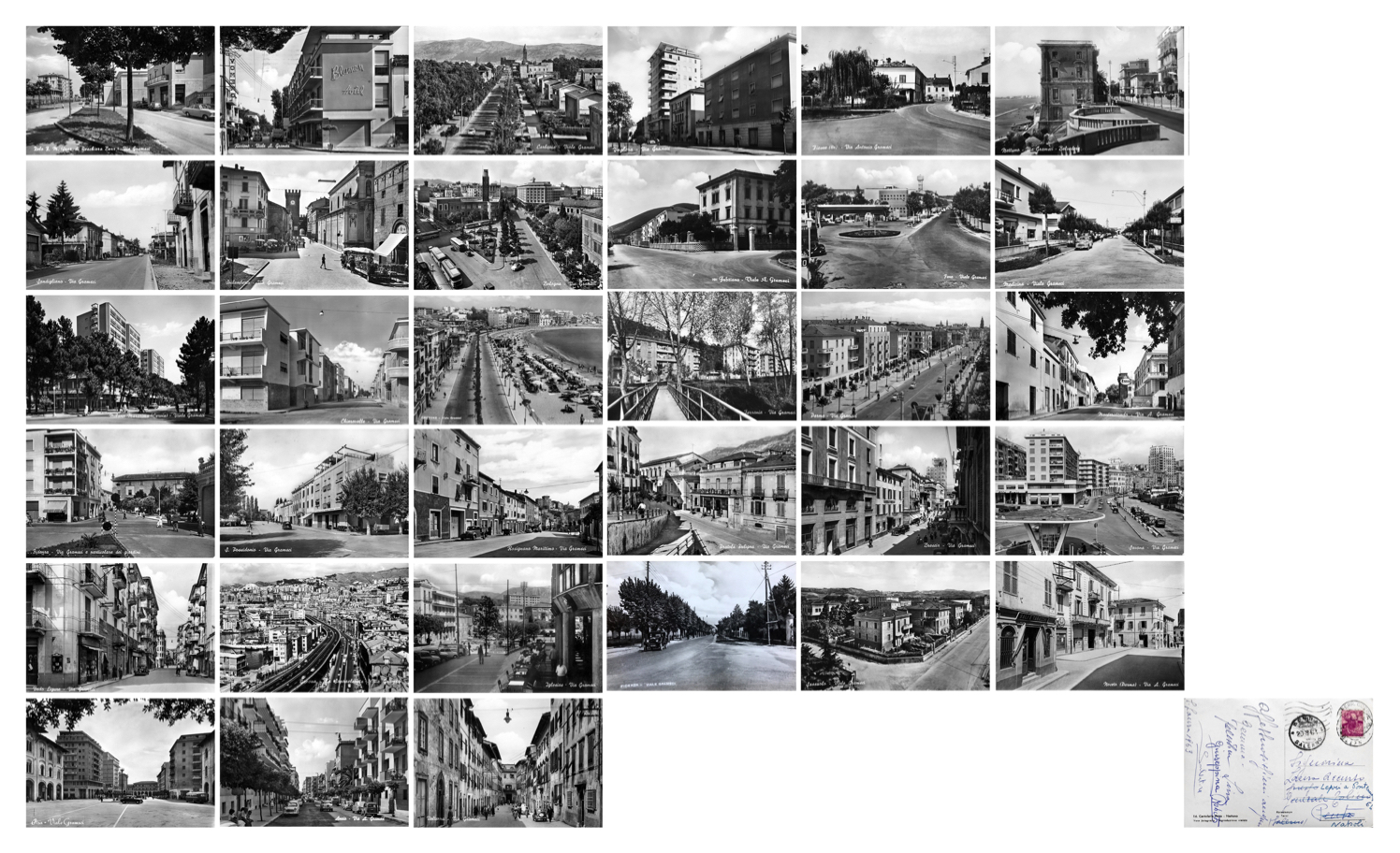
33 + 1 vedute di Via Gramsci
english / italiano
installation | 34 original postcards (posted) (14.8x10.3cm each postcard) | silver gelatin prints | unique copy | 2017
“I am subjected to various prison regimes: there is the prison regime made up of the four walls, the grating, the wolf’s mouth (…). What I had not anticipated was the other prison, added to the first: being cut off not only from social life but from family life too.”
Antonio Gramsci, letter of 19 May 1930.
Arrested at home on 8 November 1926, despite his parliamentary immunity, Gramsci is locked up in Regina Coeli; then comes internal exile on Ustica and, from 7 February 1927, Milan’s San Vittore prison.
His trial before the Fascist Special Tribunal opens on 28 May 1928: conspiracy, incitement to civil war, advocating crime, incitement to class hatred. On 4 June he is sentenced to twenty years, four months and five days; on 19 July he reaches the prison of Turi, in the province of Bari. He will die in 1937, after eleven years in prison.
In those years he begins writing the Prison Notebooks: thirty-three, perhaps thirty-four. Historians still debate the last one: it has never been found, but it is presumed to have been written.
33 + 1 vedute di Via Gramsci (33 + 1 views of Via Gramsci) is a work about the memory of a great man of culture.
Thirty-three postcards, as there are thirty-three notebooks, plus one more: turned over, its image hidden, only the back in view. Perhaps the thirty-fourth notebook.
Picture postcards were made to promote the artistic and natural beauty of a place. These show avenues, squares, apartment blocks, seafronts: places that are not necessarily interesting or beautiful, but places of remembrance. They show that Gramsci’s isolation was not enough to make the politician and the philosopher forgotten: his name, and the affection it stirred, spread across Italy, where from the largest city to the village of a few souls a street was named after him — almost a personal redemption.
The image therefore has a double value: Via Gramsci shows us the urban Italy of the 1950s and 60s and, at the same time, how important a figure Antonio Gramsci was.
For the view chosen for a postcard, among the many available, speaks of the character and feelings of the person sending the message and tells of the culture of the time: the postcard entrusts its message to an image reproduced in many copies, and is for that reason an expression of social custom.